
Category: Uncategorized

Uncategorized

What “Big Pharma” Patents Signal About Cannabis’ Medicinal Potential…

When numerous large pharmaceutical companies file patents related to synthetic cannabinoids and cannabinoid-receptor medicines, it’s a strong signal that cannabis chemistry is not just cultural—it’s drug-relevant biology with plausible medical utility. A patent is not medical proof, but it does reflect serious scientific and commercial investment in cannabinoid-based therapeutics. [1][2]

Important FDA context (disclaimer up front): The FDA has not approved marijuana (the plant) as a treatment for any medical condition. However, the FDA has approved specific cannabinoid medicines (including a cannabis-derived cannabidiol drug and certain synthetic cannabinoid drugs) for specific medical uses, meaning those particular products met FDA standards for safety and effectiveness for their labeled indications. [3][4]

So what does it mean when big pharma patents in this space—even while cannabis remains restricted under federal law in many forms? It means the medical and commercial worlds are preparing for the reality that cannabinoid-based therapies have acknowledged, evidence-supported benefits in specific contexts, and that standardized cannabinoid medicines are a long-term category worth building. [3][5]

__________________________________________________________________________

Educational + FDA disclaimer 

Educational disclaimer: This material is for educational purposes only and is not medical advice. Individual responses vary. Consult a licensed healthcare professional before use, especially if you are pregnant or nursing, have a medical condition, or take medications.

FDA disclaimer: The FDA has not approved marijuana (cannabis) as a treatment for any disease or condition. The FDA has approved certain cannabinoid-based prescription medicines for specific indications. This content does not claim to diagnose, treat, cure, or prevent any disease.


What Patents Actually “Validate” – and What They Don’t

What patents do signal

To receive a patent, an applicant must describe an invention with a specific and substantial utility, and that utility must be credible to someone skilled in the field. [1] In plain English: if a company files cannabinoid patents, it’s because they believe they can credibly claim a real-world therapeutic use for a specific invention (like a molecule, formulation, or method of treatment). [1]

That doesn’t prove a product works for patients—but it does signal cannabinoid biology is medically plausible and worth serious R&D. [1]

What patents don’t prove

A patent is not the same as FDA approval. Patent examination is not a clinical trial process, and a patent grant is not a finding that a therapy is safe or effective in people. [1][3]

Also, a patent does not automatically grant the right to sell a product. A U.S. patent is primarily a right to exclude others from making/using/selling the claimed invention—regulatory approval and legal compliance are separate issues. [2][6]


Why Big Pharma Files Synthetic Cannabis Patents

Pharmaceutical companies generally aren’t trying to “patent the cannabis plant.” Instead, they patent human-made inventions that can become standardized medicines. The motivations usually look like this:

  1. Precision and repeatability (medicine requires consistency).
    Drug development is built around exact dosing, stable formulations, and predictable effects. Synthetic or highly standardized cannabinoid medicines are designed for reproducibility in a way plant material can struggle to match. [3][4]
  2. Regulatory alignment.
    FDA drug approval requires well-controlled studies, consistent manufacturing, and defined active ingredients—features that align naturally with single-molecule or tightly specified cannabinoid products. [3][4]
  3. Commercial protection for expensive R&D.
    Developing a drug is costly. Patents provide time-limited exclusivity that helps justify investment in trials, manufacturing scale-up, and regulatory filings. [6]
  4. Strategic “future-proofing.”
    Even where cannabis access is restricted federally in many forms, FDA-approved cannabinoid medicines already exist—so companies continue building IP portfolios in anticipation of expanded cannabinoid-based therapeutic markets. [3][4]

Examples of “Big Pharma” Patent Activity in Cannabinoid Medicines

Below are examples of cannabinoid-related patent publications associated with major pharmaceutical companies (illustrative, not exhaustive):

  • Sanofi: CB2 receptor agonist compounds (immunomodulating drug preparation). [7]
  • Pfizer: cannabinoid receptor ligands and uses thereof. [8]
  • Merck (Merck Sharp & Dohme): cannabinoid receptor ligands (anti-inflammatory/immunomodulatory activity described). [9][10]
  • Glaxo (GSK): CB2-related modulators for disease treatment (pain and cannabinoid-receptor activity referenced). [11]
  • Bristol Myers Squibb: CB1 receptor antagonists. [12]
  • Abbott (Abbott Laboratories): indoles as cannabinoid receptor ligands. [13]

These patents reflect a common theme: pharma is often targeting the endocannabinoid system (CB1/CB2 and related pathways) in drug-like ways (selective, doseable, consistent). [1][7–13]


Even Though It’s Not Federally Legal, There Are Acknowledged Medical Benefits

  • Cannabis as a general category is not FDA-approved medicine. [3][4]
  • Specific cannabinoid-based medicines have been FDA-approved for specific indications (including purified cannabidiol and synthetic cannabinoid drugs). [3][4]
  • Independent evidence reviews have found conclusive or substantial evidence for cannabis/cannabinoids in certain therapeutic contexts, including chronic pain in adults, chemotherapy-induced nausea/vomiting (oral cannabinoids), and MS spasticity symptoms (oral cannabinoids). [5][14]

Taken together, this is why pharma patenting matters: it’s not a “stamp of approval” on every cannabis claim—but it is a real-world acknowledgment that cannabinoids are medically relevant enough to justify both clinical developmentand IP strategy. [1][3][5]

___________________________________________________________________________

References 

  1. USPTO — MPEP 2107 Utility Requirement (credible, specific, substantial)
    https://www.uspto.gov/web/offices/pac/mpep/s2107.html
  2. USPTO — Patent essentials: patents are a right to exclude
    https://www.uspto.gov/patents/basics/essentials
  3. FDA — Cannabis: Research and Drug Approval Process
    https://www.fda.gov/news-events/public-health-focus/fda-and-cannabis-research-and-drug-approval-process
  4. FDA — Regulation of Cannabis and Cannabis-Derived Products (including CBD)
    https://www.fda.gov/news-events/public-health-focus/fda-regulation-cannabis-and-cannabis-derived-products-including-cannabidiol-cbd
  5. National Academies — The Health Effects of Cannabis and Cannabinoids (2017) overview
    https://www.nationalacademies.org/publications/24625
  6. USPTO — Managing a patent (patent doesn’t grant right to use; “right to exclude”)
    https://www.uspto.gov/patents/basics/manage
  7. Sanofi — US6013648A “CB2 receptor agonist compounds” (Google Patents)
    https://patents.google.com/patent/US6013648A/en
  8. Pfizer — US7176210B2 “Cannabinoid receptor ligands and uses thereof” (Google Patents)
    https://patents.google.com/patent/US7176210B2/en
  9. US7507767B2 “Cannabinoid receptor ligands” (Google Patents)
    https://patents.google.com/patent/US7507767B2/en
  10. US7067539B2 “Cannabinoid receptor ligands” (Google Patents)
    https://patents.google.com/patent/US7067539B2/en
  11. Glaxo — US20070129367A1 “Pyridine derivatives as CB2 receptor modulators” (Google Patents)
    https://patents.google.com/patent/US20070129367A1/en
  12. Bristol Myers Squibb — US7452892B2 “CB1 antagonists” (Google Patents)
    https://patents.google.com/patent/US7452892B2/en
  13. Abbott — US7560481B2 “Indoles are cannabinoid receptor ligands” (Google Patents)
    https://patents.google.com/patent/US7560481B2/en
  14. Abrams (2018) PubMed — “The therapeutic effects of Cannabis and cannabinoids”
    https://pubmed.ncbi.nlm.nih.gov/29325791/
Uncategorized

Cannabis Wellness Capsules 101: Understanding What They Are &…

Cannabis capsules (often softgels) are one of the most routine-friendly ways to use cannabis: measured milligrams, discreet, no smoke, and longer-lasting effects. This guide focuses on two common capsule styles—Live Resin softgels and Premium Cannabis Oil (PCO) softgels—and how to choose between them.


1) Why there’s “substantial evidence” cannabis can help chronic pain in adults

A major reason people explore oral cannabis formats is pain management. In the National Academies’ comprehensive review, the committee concluded:

  • “There is substantial evidence that cannabis is an effective treatment for chronic pain in adults.” [1]

What that generally means in evidence-speak:

  • Across multiple clinical studies, patients using cannabis/cannabinoids were more likely than placebo to report meaningful reductions in pain symptoms, though effects can be modest and vary by pain type. [1]
  • More recent evidence syntheses (AHRQ’s living systematic review updates) suggest some oral cannabinoid products are probably associated with small improvements in pain severity and function, while also showing increased risks of side effects like dizziness, sedation, and nausea depending on the THC/CBD ratio and product type. [2]

Important context: the research base still has limitations—many trials are short-term, use specific formulations, and don’t perfectly match every product in the retail market. [2]


2) Why “pharmaceutical-style” capsules fit pain routines

People managing chronic pain often prioritize repeatability. Capsules are popular because they support a consistent routine:

  • Precise dosing: the label milligrams map cleanly to “what I took last time.”
  • Discreet and familiar: swallowable format, no odor, no device.
  • Longer coverage: compared with inhalation, oral formats can last much longer—often preferred for nighttime pain or all-day steadiness.
  • Less respiratory irritation: a common reason people avoid inhalation.
  • Lower “extra ingredients”: compared with many gummies/edibles (less sugar, fewer additives).

Buddies’ product descriptions also position their THC softgels as a convenient, cost-effective option for people seeking a controlled experience. [6]


3) Why more people are choosing oral cannabis

Oral cannabis (“edibles,” including capsules) has grown in popularity for real-world reasons:

  • Discretion and convenience
  • Longer-lasting effects
  • Avoiding smoking/vaping
  • Easier integration into wellness routines

A naturalistic study on legal-market products notes that orally administered cannabis products are increasing in popularity, referencing Colorado point-of-sale trends and broader market shifts. [7]


4) Buddies Brand (and the two capsule types we’re comparing)

Buddies Brand is a West Coast cannabis manufacturer rooted in a “genuine cannabis experience,” drawing on 20+ years of cultivation and processing experience. [4] The company set out in 2017 to raise the bar by offering “100% cannabis products with full ingredient transparency,” and it emphasizes that its concentrates are derived solely from 100% cannabis (i.e., not cut with non-cannabis additives). [3] Buddies is also a multi-market brand across West Coast states and publicly highlights a track record of industry awards (including High Times Cannabis Cup and Leaf Bowl wins) as part of how it signals consistency and quality. [3][4]

In capsules/softgels, two key styles show up often:

  • Buddies Live Resin Softgels (strain-specific, “full spectrum” positioning). [5]
  • Buddies Premium Cannabis Oil (PCO) THC Softgels (potent, controlled, cost-effective positioning). [6]

5) Live Resin vs Premium Cannabis Oil Softgels: what they are, and what “broad spectrum” means

Live Resin softgels (definition)

Live resin is commonly made from fresh-frozen cannabis to better preserve the plant’s aromatic compounds. Buddies’ Live Resin softgel listings describe each softgel as capturing a full spectrum of strain-specific cannabinoids and terpenes. [5]

Premium Cannabis Oil (PCO) softgels (definition)

Buddies defines Premium Cannabis Oil as a purification approach that removes and separates cannabinoids from other plant compounds—including terpenes—leaving a final oil largely stripped to cannabinoids like THC/CBD. [4]

Broad spectrum + entourage effect (plain-English)

  • Broad/full spectrum (in practice): more of the plant’s compounds together (multiple cannabinoids + terpenes), rather than mostly isolated cannabinoids. [4][5]
  • Entourage effect (the idea): the combined mix may shape effects differently than a single compound alone. It’s widely discussed, but the science is still debated; reviews note both advocacy and criticism, and some studies do not find terpene-driven synergy at CB1/CB2 receptors. [10][11]

Practical takeaway

  • If you want the most “whole-plant / strain-character” experience, Live Resin softgels are more likely to align with that goal (because they’re described as including cannabinoids + terpenes). [5]
  • If you want a more streamlined, THC-forward, consistent routine (and often a more cost-driven choice), PCO/THC softgels tend to fit better (because the process is described as stripping out terpenes and other compounds). [4][6]

6) Onset and duration: what to expect with capsules

Because capsules are digested and metabolized, effects are typically slower to start and longer to last than inhalation.

Common timing ranges reported for oral THC/edibles:

  • Onset: often ~1–3 hours [8]
  • Peak: around ~3 hours on average (varies) [8]
  • Duration: can persist for many hours; some reports note effects dissipating within 24 hours depending on dose and individual factors. [8]

Food can change how capsules hit: a controlled pharmacokinetic study found fed vs. fasted conditions altered THC capsule absorption and related measures (including the active metabolite 11-OH-THC). [9]


7) Real-world feedback (what customers report)

Buddies Live Resin softgels show strong consumer sentiment on major menus:

  • iHeartJane lists Buddies “25mg Indica [40ct] (1000mg)” at 5.0/5 stars (16 reviews). [12]
  • Weedmaps lists Buddies “Live Resin Softgels | Indica | 25mg | 40ct” at ~4.9/5 average (with many ratings). [13]

Customer reviews are helpful for “what it felt like,” but they’re anecdotal and shouldn’t be treated as medical proof.


8) How The Good People Farms helps you choose (safely)

  • Start low, go slow: oral cannabis takes time—avoid taking more too soon. [8]
  • Plan the window: capsules can last for hours; choose a time when you can fully ride it out. [8]
  • All the products we sell at The Good People Farms have Certificates of Analysis (COA’s). Potency and lab testing are always verified so you can feel confident about the product you purchase.

Live Resin vs Premium Cannabis Oil Softgels: Quick Checklist

FeatureBuddies Live Resin SoftgelsBuddies Premium Cannabis Oil (PCO) THC Softgels
What’s inside (as described)Strain-specific cannabinoids and terpenes (“full spectrum” positioning) [5]Purified oil described as stripping out compounds including terpenes [4]
“Broad spectrum” feelMore likely to feel “whole-plant” [5]More THC-forward / streamlined [4][6]
Entourage potentialMore plausible by composition, but still debated [10][11]Less terpene contribution by definition [4]
Why people choose itNuance, “strain personality,” broad/full-spectrum preferenceValue, consistency, controlled THC routine
Onset + durationSimilar (both oral): slow onset, long duration [8][9]Similar (both oral): slow onset, long duration [8][9]

Education + FDA disclaimer 

This article is for education only and does not provide medical advice. Cannabis affects everyone differently. Do not drive or operate machinery while impaired. Keep cannabis products away from children and pets.

FDA disclaimer: The FDA has not approved cannabis (marijuana) for the treatment of any disease or condition, and cannabis-based products in state-legal markets are not FDA-evaluated the way approved prescription drugs are. [14]


References 

  1. National Academies (2017) — Therapeutic Effects: “Substantial evidence” for chronic pain in adults
  2. AHRQ (2025) — Living Systematic Review: Cannabis and plant-based treatments for chronic/subacute pain (Executive Summary)
  3. Buddies Brand — California products (Softgels)
  4. Buddies Brand — FAQ (Premium Cannabis Oil definition; terpenes removed)
  5. Weedmaps — Buddies Live Resin Softgels product description (full spectrum; strain-specific cannabinoids + terpenes)
  6. Weedmaps — Buddies THC Softgels product description (precise dosing; cost-effective; variety of mg options)
  7. Bidwell et al. — Naturalistic study of oral vs inhaled legal-market cannabis (PMC)
  8. Barrus et al. — “Tasty THC: Promises and Challenges of Cannabis Edibles” (PMC)
  9. Lunn et al. — Fed vs fasted alters oral THC capsule pharmacokinetics (PubMed)
  10. Christensen et al. (2023) — Review discussing the “entourage effect” debate (PMC)
  11. Finlay et al. (2020) — Terpenoids do not explain entourage via CB1/CB2 (Frontiers)
  12. iHeartJane — Buddies “25mg Indica [40ct] (1000mg)” (rating/reviews)
  13. Weedmaps — Buddies Live Resin Softgels | Indica | 25mg | 40ct (ratings)
  14. FDA — Cannabis: Research and Drug Approval Process
Uncategorized

Cannabis Wellness 101: How Topicals, Tinctures, Capsules & Patches…

When people hear “cannabis,” they often picture smoking flower or eating edibles and immediately wonder:

“Am I going to get high?”

But cannabis wellness products—like topicals, tinctures, capsules, and transdermal patches—can work very differently in the body. Some are designed for local relief with no high, while others have whole-body effects that can be intoxicating depending on the dose and THC:CBD ratio.

In this guide, you’ll learn:

  • How these products interact with your endocannabinoid system (ECS)
  • The differences between tinctures, balms, capsules, and patches
  • When you’re likely to feel high (and when you’re not)
  • How award-winning wellness brand Papa & Barkley fits into each category
  • Reminder: the sale of cannabis products are fulfilled through our Type 9-licensed delivery business at TheGoodPeopleFarms.com 

Important Medical & FDA Reminders

  • Everyone’s body is different. This article is for education only and is not medical advice.
  • Always talk with your healthcare provider, especially if you take other medications, are pregnant or breastfeeding, or have underlying health conditions.

FDA Disclaimer: These statements have not been evaluated by the Food and Drug Administration. Cannabis and CBD products are not intended to diagnose, treat, cure, or prevent any disease.


1. Your Endocannabinoid System: The “Why” Behind Cannabis Wellness

Your body has its own cannabis-like network called the endocannabinoid system (ECS). It includes:

  • Receptors (CB1, CB2 and others) found in the brain, nerves, skin, immune cells, gut and more
  • Endocannabinoids – signaling molecules your body makes naturally
  • Enzymes – that build and break those molecules down

Plant cannabinoids like THC and CBD interact with this system and with other receptors involved in pain, inflammation, mood, sleep, and stress.

How a product is delivered—through your skin, under your tongue, through your stomach, or slowly via a patch—changes:

  • Where it acts (local vs. whole-body)
  • How fast you feel it
  • How long it lasts
  • Whether you’re likely to feel “high”

 2. Topicals & Balms: Local Relief, No High (for Most People)

What are cannabis topicals?

Topicals are products like creams, balms, lotions, and body oils that you apply directly to the skin for targeted relief—think sore shoulders, tight lower back, or achy knees.

How they work

  • Cannabinoids in the topical interact with receptors in the skin and nearby tissues, especially CB2 and local CB1receptors on nerve endings and immune cells.
  • They typically do not move deeply into the bloodstream, so effects stay mostly where you put them.

Onset & duration

  • Onset: often within minutes to about an hour
  • Duration: often several hours of localized relief for many people

Will a topical or balm get me high?

For standard topicals (non-patch):

Very unlikely.

Because the cannabinoids generally don’t reach the brain in meaningful amounts, most peopledo not feel a head-high from THC balms or creams. You may notice:

  • Looser, more comfortable muscles
  • Reduced soreness or stiffness
  • A general sense of physical ease

…but not the classic “stoned” sensation.

Papa & Barkley Spotlight: Releaf Balm

Papa & Barkley Releaf Balm (in CBD:THC ratios like 1:3 or 3:1) is an award-winning, full-spectrum topical made using a solventless, chemical-free infusion of cannabis into whole-plant oils.

It’s designed to be:

  • Site-specific – you put it exactly where you need support
  • Non-intoxicating for most people
  • A gentle first step into cannabis wellness if you’re canna-curious but not ready to feel high

At The Good People Farms, Releaf Balm is one of our favorite “start here” options for new wellness customers.


3. Tinctures: Under-the-Tongue Drops for Whole-Body Effects

What is a cannabis tincture?

A tincture is a liquid cannabis product—usually cannabinoids infused into oil or alcohol—that you measure with a dropper.

You can:

  • Place drops under your tongue (sublingual)
  • Swallow them directly or mix into food/drinks (oral)

How tinctures work in your body

Sublingual use (under the tongue):

  1. Hold the tincture under your tongue for about 60 seconds.
  2. Cannabinoids are absorbed through tiny blood vessels and go directly into your bloodstream.
  • Onset: often 15–30 minutes
  • Duration: roughly 4–6 hours

Swallowed like an edible:

  • The tincture goes through your stomach and liver, similar to an edible.
  • Onset: about 45–90 minutes
  • Duration: often 6–8+ hours

Once in your bloodstream, THC and CBD circulate throughout the body, interacting with CB1 receptors in the brain and nervous system and CB2 receptors in immune and peripheral tissues.

Will a tincture get me high?

It depends on the ratio and dose:

  • THC-dominant or balanced (e.g., 1:1, 1:3 CBD:THC)
    • Yes, these can be intoxicating—especially at higher doses or if you’re new to THC.
  • CBD-rich (e.g., 30:1 CBD:THC or CBD-only)
    • Typically non-intoxicating or only mildly relaxing, though very sensitive people might feel subtle psychoactive effects.

Papa & Barkley Spotlight: Releaf Tinctures

Papa & Barkley Releaf Tinctures come in multiple ratios—such as 30:1 CBD:THC (CBD-forward) as well as more balanced formulas—to match different comfort levels.

  • CBD-forward tinctures → great for body support with minimal high.
  • Balanced ratios → more noticeable mood and body effects, including mild to moderate intoxication at higher doses.

Tincture tips:

  • Start with a small dose (for example, 0.25–0.5 ml), especially with THC.
  • Try your first dose in the evening if you’re worried about feeling high.
  • Increase slowly over several days until you find your “sweet spot.”

4. Capsules: Edible-Style Relief in an Easy Dose

How capsules work

Capsules are swallowed and behave much like traditional edibles:

  • They travel through your digestive system.
  • THC and CBD are absorbed in the gut and processed by the liver, where THC is converted into 11-OH-THC—a metabolite that can feel stronger and longer-lasting than inhaled THC.

Typical timing:

  • Onset: usually 45–90 minutes
  • Duration: often 6–8+ hours

Will capsules get me high?

It depends on the THC content and ratio:

  • THC-dominant capsules – Very likely to produce a classic edible-type high at sufficient doses.
  • Balanced CBD:THC capsules – Still can be intoxicating but may feel more “even” or body-focused.
  • CBD-only or CBD-rich – Typically non-intoxicating, though many people find them calming or relaxing.

Capsules Deliver:

  • Precise, consistent dosing
  • A familiar pill format
  • Discreet, long-lasting effects

Perfect for people who want a clean ingredient list and set-and-forget wellness support.

Capsule caution: Because capsules behave like edibles, it’s easy to take too much and only feel it later. Start low and give it at least 2 hours before considering another dose.


5. Transdermal Patches: Slow & Steady, Through the Skin

How patches work

Transdermal patches are very different from regular topicals:

  • They’re formulated with permeation enhancers that allow cannabinoids to cross the skin barrier and enter the bloodstream over time.
  • They provide a slow, steady delivery of cannabinoids for 8–12 hours or longer, depending on the product.
  • They can offer both local and whole-body effects.

Will a transdermal patch get me high?

It can, especially with THC-dominant patches:

  • Because cannabinoids enter the bloodstream, a THC patch can cause psychoactive effects—often more gradual and steady than an edible.
  • Many people describe gentle, whole-body relief, a possible subtle head effect, and less of the “up and down” rollercoaster typical of edibles.

Papa & Barkley Spotlight: Releaf Patches

Papa & Barkley Releaf Patches come in various CBD:THC ratios (such as 1:1, 3:1, and others) and are part of their award-winning topicals lineup.

They’re often chosen by people who:

  • Want steady, all-day support
  • Prefer not to keep re-applying cream or balm
  • Would like some of THC’s potential benefits but don’t want intense peaks

🩹 Patch tip: If you’re new to THC, choose a lower-dose or CBD-rich patch and try it on a low-stakes day so you can see how your body responds.


6. “Will I Get High?” – Quick Comparison

Here’s a simple, at-a-glance guide:

Product TypeWhere It WorksOnset (Typical)How Long It Lasts*Will I Get High?
Topicals / Balms Skin & nearby tissuesMinutes–1 hourSeveral hoursUnlikely – usually local only
Tinctures (subling.)Whole body (bloodstream)15–30 min4–6 hoursYes, if THC or balanced; CBD-rich usually not
Tinctures (swallowed) Whole body (like edibles)45–90 min6–8+ hoursYes, if THC or balanced
Capsules Whole body (like edibles)45–90 min6–8+ hoursYes, if THC or balanced; CBD-only usually not
Transdermal PatchesBloodstream via skin~15–60 min8–12+ hoursCan be – often mild/steady with THC

*Actual times vary by person, dose, and product.


References

  1. Mary Jane’s Medicinals. How Do CBD and THC Work in Cannabis Topicals? Here’s What the Science Says.2023.maryjanesmedicinals.com
  2. Seattle Hashtag. Everything You Need to Know About Cannabis Topicals. 2022.Hashtag Cannabis
  3. Veriheal; EO Care; Sweet Releaf. Articles on topical THC absorption and psychoactivity, 2023–2025.Veriheal+2EO Care+2
  4. Mission Dispensaries; Emerald Bay Extracts; Orange County Cannabis Co; A Therapeutic Alternative. Guides to tincture onset and sublingual dosing, 2024–2025.
  5. Chayasirisobhon S. Mechanisms of Action and Pharmacokinetics of Cannabis. Perm J. 2020.PMC
  6. Batch. THC Tincture 101: Is It Stronger Than Edibles? 2023.BATCH
  7. Papa & Barkley. 1:3 Releaf Balm product page; Topicals collection.papaandbarkley.com+1
  8. Mahmoudinoodezh H et al. The Transdermal Delivery of Therapeutic Cannabinoids. 2022; plus multiple dispensary guides to THC patches.A Therapeutic Alternative+6PMC+6papaandbarkley.com+6
  9. Weedmaps. The Products That Made Papa & Barkley. 2021.Weedmaps
  10. Papa & Barkley. Brand homepage and product catalog (tinctures, capsules, topicals).Papa & Barkley+3papaandbarkley.com+3papaandbarkley.com+3
Uncategorized

What Are Cannabis Topicals? How Can They Help Me?…

Topicals: Local relief, no high (for most people)

Cannabis topicals are products like creams, balms, lotions, roll-ons, and body oils that you apply directly to the skin for targeted, “right-here” relief—think sore shoulders, tight lower back, or achy knees. [1][2]

The quick distinction that matters

  • Topicals are generally intended to work locally in the skin and nearby tissues. [1]
  • Transdermals (often patches, and some specialized “transdermal” lotions) are designed to cross the skin barrier and can deliver cannabinoids into the bloodstream, creating more whole-body effects. [1][3]

What are cannabis topicals?

Topicals are cannabis-infused products intended for external use on skin (not ingestion). People commonly choose them because they’re:

  • Targeted (apply where you want relief)
  • Discreet (no smoke, no odor cloud)
  • Routine-friendly (easy to add to post-workout or bedtime wind-down)

How do cannabis topicals work?

Your skin has its own “local” endocannabinoid system. Research shows cannabinoid signaling is involved in skin functions like barrier, inflammation, and immune activity, and CB1/CB2 receptors (and related signaling pathways) are present in skin cells and structures. [4][5][6]

In plain English: when you apply a topical, cannabinoids may interact with receptors in the skin and nearby tissuesthat influence how your body handles irritation, soreness, and inflammatory signaling in that area. [4][5][6]

Important reality check: clinical evidence for topical cannabis products is still limited, and experts note major knowledge gaps (including absorption, dosing, and timing). [1]


Onset and duration

Because topical products vary a lot (formula base, cannabinoid strength, “warming/cooling” ingredients like menthol, how much you apply, and your skin), timing is not perfectly predictable.

  • Many people report feeling something within minutes up to about an hour, then relief that can last a few hours—but formal research doesn’t yet give one universal timing rule. [1][7]
  • Knowledge gaps specifically include time to onset, peak, and duration for topical cannabis products. [1]

Will a topical get me high?

For standard topicals (non-patch): very unlikely for most people.
A clinical pharmacy review notes there’s a lack of reports of THC-containing topical products causing euphoria in the medical literature/public forums; however, it also warns that using cannabinoids on compromised skin (cracks/wounds) or using transdermal lotions/patches may lead to higher blood levels and potential psychoactive effects. [1]

Bottom line:

  • Standard creams/balms/roll-ons: typically localized, “no head high” for most people. [1]
  • Transdermals/patches (or broken skin): greater chance of systemic absorption (whole-body effects, possibly psychoactive if THC is involved). [1][3]

Spotlight on an award winner:

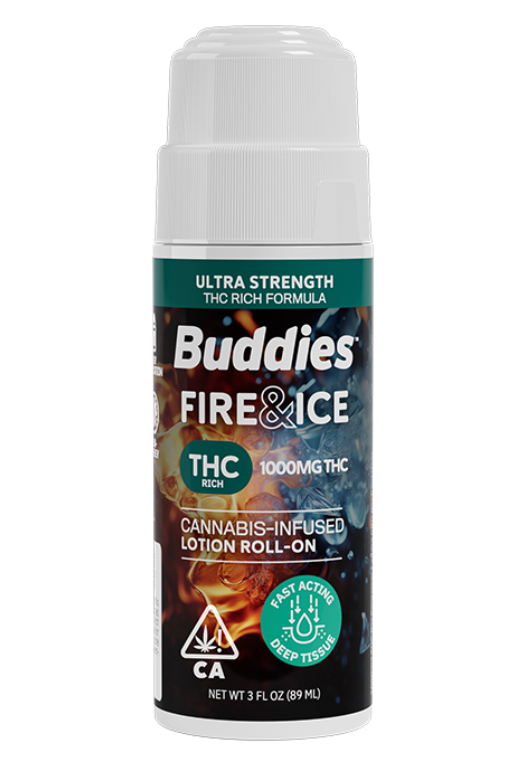
Buddies Fire & Ice (Extra, Ultra, Max)

Buddies Brand’s Fire & Ice line is built around a simple idea: fast-acting, targeted topical relief with a signature sensation—warming first, then cooling—delivered through an easy roll-on format. Buddies specifically calls out ingredients like menthol, camphor, eucalyptus, and cinnamon behind that “fire then ice” effect. [8]

What’s the difference between Fire & Ice Extra, Ultra, and Max?

Here’s the simplest way to choose:

Fire & Ice Extra (1:1 CBD:THC)

Best for: people who want balanced, dual-action support—equal parts CBD and THC—often chosen when someone wants “support + function” without going ultra THC-heavy. [8]
Why it’s different: 1:1 CBD:THC ratio (Buddies positions this as a balanced approach for pain and inflammation). [8]

Fire & Ice Ultra (1000mg THC)

Best for: those seeking ultra-strength, targeted THC topical potency for stubborn, localized discomfort (especially after physical activity). [8]
Why it’s different: Buddies highlights 1000mg THC as the “strong solution” option. [8]

Fire & Ice Max (THC + CBD + CBG + CBN)

Best for: customers who want the most cannabinoid-packed formula in the line—Buddies frames this as “maximum relief” with an advanced recovery blend. [8]Why it’s different: combines THC + CBD + CBG + CBN in one topical; Buddies calls it their most cannabinoid-dense topical to date (availability varies by state). [8]


Fire & Ice awards and recognition

Buddies lists Fire & Ice as a decorated topical line, including:

  • Best Topical – Fire & Ice (High Times Cannabis Cup, 2014). [9]
  • 1st Place Topical – Fire & Ice (Oregon Grower’s Cup, 2023). [9]
  • Best Topical: Fire & Ice Roll-On Lotion 1000mg THC (California Leaf Bowl, 2025). [10]
  • Best Topical: Fire & Ice Roll-On Lotion 1000mg THC (WeedCon Ice Bowl, 2025). [10]
  • Best Topical Brand (NuggMD Patient Choice Award, 2025). [10]
  • Runner Up – Best Topical: Fire & Ice Max (NW Leaf Bowl, 2025). [10]
  • Runner Up – Best Topical: Fire & Ice 1000mg THC roll-on lotion (OR Leaf Bowl, 2025). [10]

How The Good People Farms helps you choose

  • Match the formula to your goal: balanced (Extra), THC-forward (Ultra), or multi-cannabinoid (Max). [8]
  • Use it like a trial: start with a small area, wait, then adjust. (Topicals are highly individual.) [1]
  • Protect your eyes and pets: wash hands after applying; avoid face and broken skin. [1]
  • All the products The Good People Farms sell come with Certificates of Analysis (COA’s) so potency and lab testing are always verified.

Education + FDA disclaimer 

This article is for education only and does not provide medical advice. Cannabis affects everyone differently. Keep cannabis products away from children and pets. Do not use cannabis products if it is unsafe or illegal for you to do so.

FDA disclaimer: The FDA has not approved cannabis products from state-legal markets as treatments for disease, and it continues to evaluate safety and regulatory considerations for cannabis and cannabis-derived products. [11]


References 

[1] RxFiles (University of Saskatchewan) — Topical Cannabis: Does it Live Up to its Presumed Potential? (2019) https://www.rxfiles.ca/rxfiles/uploads/documents/QandA-Topical%20Cannabis.pdf
[2] Patel & Lio — Safety and Sourcing of Topical Cannabinoids: Many Questions, Few Answers (J Clin Aesthet Dermatol, 2021; PMC) https://pmc.ncbi.nlm.nih.gov/articles/PMC8570654/
[3] Mahmoudinoodezh et al. — The Transdermal Delivery of Therapeutic Cannabinoids (Pharmaceutics, 2022; PMC) https://pmc.ncbi.nlm.nih.gov/articles/PMC8876728/
[4] Bíró et al. — The endocannabinoid system of the skin in health and disease (Trends Pharmacol Sci, 2009; PMC) https://pmc.ncbi.nlm.nih.gov/articles/PMC2757311/
[5] Tóth et al. — Cannabinoid Signaling in the Skin: Therapeutic Potential of the “C(ut)annabinoid” System(Molecules, 2019; PMC) https://pmc.ncbi.nlm.nih.gov/articles/PMC6429381/
[6] Baswan et al. — Therapeutic Potential of Cannabidiol (CBD) for Skin Health and Disorders (CCID, 2020) https://www.dovepress.com/therapeutic-potential-of-cannabidiol-cbd-for-skin-health-and-disorders-peer-reviewed-fulltext-article-CCID
[7] Takoma Wellness — Cannabis Topicals: How Do They Work? (onset/duration ranges; retail guidance) https://takomawellness.com/topical-thc-how-do-cannabis-topicals-work/
[8] Buddies Brand — Products: Topicals (Fire & Ice Extra / Ultra / Max descriptions)https://buddiesbrand.com/products/
[9] Buddies Brand — About (brand positioning + awards list including High Times 2014, Oregon Grower’s Cup 2023)https://buddiesbrand.com/about/
[10] Buddies Brand — Homepage awards section (Leaf Bowl/WeedCon/NuggMD listings for Fire & Ice)https://buddiesbrand.com/
[11] FDA — Regulation of Cannabis and Cannabis-Derived Products https://www.fda.gov/news-events/public-health-focus/fda-regulation-cannabis-and-cannabis-derived-products-including-cannabidiol-cbd

Uncategorized

Flavor Infused Cannabis Vape Cartridges: What’s In Them and…

At our Third Street storefront and with our cannabis delivery business, one of the most common vape questions we hear is: “Is a flavor-infused cart ‘less real’ or less safe than a classic strain cart?”

We’ve got the answer for you: With licensed, tested cannabis products like the ones sold at The Good People Farms, all the products are tested, traceable and show exactly what in the oil and what’s added or not. And that’s what matters. Licensed cannabis retail business like The Good People Farms only sell products that have Certificates of Authenticity (COA’s) that tell you what is exactly in the product you are consuming, while also providing this information on the product itself. [1–3]

This guide breaks down the two big categories you’ll see on The Good People Farms menu:

  • Traditional “strain” / terpene-forward carts (examples: Jack Herer, Granddaddy Purple, God’s Gift)
  • Flavor-infused carts (examples: Pink Lemonade, Raspberry Parfait, Blueberry Muffin, Vanilla Cake)

1) The big similarity: most carts are “cannabis oil + terpenes + hardware”

No matter the label style, a typical cartridge includes:

  1. Cannabis extract/oil (often CO₂ oil, hydrocarbon extract, or a refined “premium cannabis oil/distillate-style” base)
  2. Terpenes (to provide aroma/flavor and help the oil perform correctly in the cartridge)
  3. Cartridge hardware (510 cartridge + battery, or an all-in-one device) [1–4]

Industry manufacturing guidance notes that many quality cartridges contain CO₂, hydrocarbon, or distilled extracts, and that flavor is commonly added—either to mimic the original cultivar/strain character or to create a different taste profile. [4]


2) A quick history: “strain carts” grew up with 510 technology

Modern cannabis cartridges largely standardized around the 510 thread (borrowed from the e-cigarette world), which helped batteries and cartridges become widely compatible. [5] Over time, cartridge technology improved—especially heating elements and wicks—to better handle thicker cannabis oils and reduce clogging/leaking issues. [6]


3) Traditional terpene / “legacy strain” carts: what they are and how they’re made

What they’re trying to deliver

Traditional strain carts are designed to taste and smell like cannabis (or like a familiar “traditional” strain profile). They’re often labeled with classic names like Jack Herer or Granddaddy Purple to signal a specific terpene style (piney/citrus vs. grape/berry, etc.). [4]

How they’re commonly made (plain English)

A manufacturer typically:

  1. Extracts cannabis into oil (CO₂, hydrocarbon, ethanol, etc.). [4]
  2. Refines it into a consistent base (often a high-potency “premium cannabis oil” or distillate-style oil).
  3. Adds terpenes to create a target profile—sometimes cannabis-derived terpenes for a more “true-to-cannabis” taste, sometimes other terpene sources depending on the product goal and price point. [3][4]

A key nuance: a cart labeled “Jack Herer” may be made from oil that originally came from that cultivar, or it may be a terpene recipe designed to resemble that strain’s profile—the name tells you the intended experience, but the ingredient approach varies by brand. [4]


4) Flavor-infused carts: what they are and how they’re made

What they’re trying to deliver

Flavor-infused carts are designed to taste like fruit/dessert/soda profiles (Pink Lemonade, Blueberry Muffin, Raspberry Parfait, Vanilla Cake). They’re built for customers who want:

  • A smoother, sweeter taste
  • Consistency from cart to cart
  • Less “weedy” flavor (while still being cannabis) [1][2]

How they’re commonly made (plain English)

The typical formula is:

  1. A consistent premium cannabis oil base
  2. A botanical (plant-based) terpene blend (not sourced from cannabis) designed for that flavor profile
  3. Filled into a 510 cartridge or all-in-one device [1][3]

Buddies’ example: their Flavor Infused line uses premium cannabis oil and is “impeccably flavored” with natural plant-based terpenes, with “no additives,” and specifically calls out botanical terpenes. [1]

Are botanical terpenes “fake”?

No. Many terpenes exist across nature. For example, limonene can come from citrus peel or cannabis; the molecule itself is the same. The difference is usually the blend/complexity and the product’s intended taste profile. [7]


5) “Are flavor-infused carts unsafe?” The real safety story

The concern is understandable

People remember the 2019 EVALI lung injury outbreak and worry that flavors mean “mystery chemicals.”

The key point

The major public-health alarm centered on illicit/untested THC vape products, where investigators strongly linked harm to additives like vitamin E acetate used as a thickener/cutting agent sold by unlicensed, (black market)  non-tested products – completely different than the highly regulated licensed, tested products sold through the legal cannabis market in California in which The Good People Farms operates. . [8–10] 

What “safer shopping” looks like in California

California requires labs to test cannabis products for a range of contaminants—including heavy metals and residual solvents/processing chemicals (among other panels). [11][12] This is one reason we emphasize documentation and lab verification.


Spotlight: Buddies (one of The Good People Farms top-selling flavor-infused vape brands)

Our customers love these products we can’t keep them in stock! Buddies is a West Coast cannabis brand offering both:

Buddies Flavor Infused Premium Cannabis Oil (510 + All-In-Ones (AIO)

  • Available as 1g 510 cartridges and all-in-one vapes [1][3]
  • Over 20 flavors [3] You can find them on our menu here.
  • Highlights premium cannabis oil + botanical (plant-based) terpenes, and emphasizes no additives [1]

Flavor examples Buddies features include Blueberry Muffin, Raspberry Parfait, Pink Lemonade, and Vanilla Cake(among many others). [1]

Buddies “classic profile” options:

Buddies also offers lines that lean more “traditional”:

  • Premium Cannabis Oil + Cannabis Derived Terpenes (PCO + CDT), positioned as strain-specific terpenes extracted in-house and reintroduced into premium oil. [3][15]
  • 100% Cured Resin 510 vapes, positioned as full-spectrum properties of indoor flower in a ceramic cart format. [3]

So if you’re deciding between styles:

  • Want fruit/dessert flavors? Buddies Flavor Infused. [1]
  • Want more cannabis-forward / strain-style taste? Consider PCO + CDT or Cured Resin. [3][15]

510 vs All-In-One (AIO): what’s the difference?

  • 510 cartridge: screws onto a compatible battery; you can swap carts without replacing the battery. [1][3]
  • AIO: the battery and oil are together in one unit (often rechargeable); convenient, no setup. [1][3]

Onset and how long it lasts (vaping)

Because vaping is inhalation:

  • Onset is fast (about 0–10 minutes)
  • Duration is usually shorter (often 2–4 hours) compared with edibles [16]

Traditional strain carts vs flavor-infused carts: similarities & differences checklist

What you’re comparingTraditional strain / terpene-forward cartsFlavor-infused carts
Main goalCannabis-forward taste / classic strain profilesFruit/dessert flavors + consistent taste
What’s usually insideCannabis oil + terpenes (often cannabis-derived or cannabis-like profiles) [4]Cannabis oil + botanical terpene blends [1][3]
Flavor examplesJack Herer, Granddaddy Purple, God’s GiftPink Lemonade, Raspberry Parfait, Blueberry Muffin, Vanilla Cake
“Inferior product?”Not inherentlyNot inherently—quality depends on sourcing + testing [8–12]
What matters mostLicensed manufacturing, testing, ingredients transparency, hardware quality [11–14]Same

How The Good People Farms helps you choose (safely)

  • Pick your “taste goal” first: cannabis-forward strain profile vs. fruit/dessert flavor.
  • Start low and go slow: inhalation hits quickly—take 1–2 pulls, then wait a few minutes before taking more. [16]
  • All the products we sell at The Good People Farms have Certificates of Analysis (COA’s). Potency and lab testing are always verified so you can feel confident about the product you purchase.

Education + FDA disclaimer 

This article is for education only and does not provide medical advice. Cannabis affects everyone differently. Do not drive or operate machinery while impaired. Keep cannabis products away from children and pets.

FDA safety note: The FDA has issued consumer communications around THC-containing vaping products and vaping-associated lung injuries, including guidance to avoid products from informal/illicit sources and warnings about additives like vitamin E acetate. [9][10]


References (hyperlinked)

  1. Buddies Flavors — Flavor Infused Premium Cannabis Oil (botanical terpenes; no additives; flavor descriptions)
  2. Buddies California — Flavor Infused Premium Cannabis Oil overview
  3. Buddies — Know Your Oil (Flavor Infused; PCO + CDT; 100% Cured Resin descriptions)
  4. Cannabis Business Times — “What’s In Your Vape Cartridge?” (extract types; terpenes added; formulation notes)
  5. Rokin Vapes — 510 thread history (origin and standardization)
  6. Smoke Cartel — Evolution of 510 cartridge technology (early designs to ceramic)
  7. Terpene Belt Farms — Botanical vs cannabis-derived terpenes (chemical identity vs blend complexity)
  8. CDC Archive — Vitamin E acetate and EVALI (THC vapes; additive concerns)
  9. FDA — THC-containing vaping products and vaping illnesses
  10. CDC MMWR — Vitamin E acetate strongly linked to EVALI outbreak
  11. California Code of Regulations — 4 CCR §15714 Required Testing (includes heavy metals, pesticides, etc.)
  12. California Code of Regulations — 4 CCR §15718 Residual Solvents & Processing Chemicals Testing
  13. Buddies — PCO + CDT positioning (reintroducing cannabis-derived terpenes)
  14. AAFP — Cannabis inhalation onset and duration (rapid onset; shorter duration)
Uncategorized

Understanding the Different Types of Cannabis Flower Strains –…

1. What Is a “Strain,” Really?

In everyday cannabis culture, “strain” is the common term for a specific variety of cannabis flower (for example, Blue Dream or Wedding Cake). Technically, many researchers prefer the word chemovar (chemical variety), because what matters most is the plant’s chemical profile—its mix of cannabinoids (like THC and CBD) and aromatic compounds called terpenes. [1]

Modern research and market testing show that:

  • The same strain name (or label) can show meaningful variation in cannabinoids and terpenes across products and markets. [2]
  • Common “indica vs. sativa” labels do not reliably map to overall genetic or chemical differences in a consistent way; they’re best treated as shorthand, not a scientific system. [2–3]

Key takeaway: Don’t rely on the name alone. The lab-tested cannabinoid and terpene profile is a better clue for what you might feel. [1–3]


2. Indica, Sativa, and Hybrid: What Those Labels Usually Mean

You’ll still see flower grouped as:

  • Sativa – commonly marketed as more “uplifting” or “daytime.”
  • Indica – often marketed as more “relaxing” or “nighttime.”
  • Hybrid – a cross of indica- and sativa-leaning genetics.

In real life, these categories overlap a lot—especially when you look at the chemistry. [2–3]

So use these words as loose guides, not guarantees. Whenever possible, look at:

  • THC % and CBD %, and
  • dominant terpenes (when listed on the COA). [1–3]

3. Cannabinoids: THC, CBD, and the Balance Between Them

THC (Δ9-tetrahydrocannabinol)

  • THC is the primary compound responsible for the classic cannabis “high.”
  • In humans, THC acts as a partial agonist at CB1 (and CB2) receptors, and CB1 activity is strongly tied to intoxication and impairment risk. [5]

CBD (Cannabidiol)

  • CBD is not intoxicating, but it is active in the body and interacts with multiple targets. [5,7]
  • A well-supported mechanism: CBD can act as a negative allosteric modulator of CB1 (meaning it can change how CB1 responds to other compounds, including THC). [6]
  • CBD also has a generally favorable safety profile in human studies, though side effects (like fatigue or GI upset) can occur depending on dose and context. [7]

Common “types” of flower (THC/CBD chemotypes)

Researchers often describe three common cannabinoid patterns (chemotypes): [8–9]

  • Type I – THC-dominant (High THC, low CBD)
    Most common in adult-use markets; more likely to feel strongly intoxicating. [9]
  • Type II – Balanced THC:CBD (THC and CBD both present at meaningful levels)
    Many people describe these as gentler or “clearer,” though experiences vary. [8–9]
  • Type III – CBD-dominant (High CBD, low THC)
    Typically produces minimal intoxication at usual doses for most adults. [8–9]

How this may affect you:
If you’re newer or prefer mild effects, a balanced or CBD-rich option is often a more comfortable start. With high-THC flower, very small amounts and patience go a long way. [4–5]


4. Terpenes: Aroma, Flavor, and Possibly the “Feel”

Terpenes are aromatic compounds that give cannabis its smell—citrusy, piney, floral, earthy—and they’re found throughout the plant world (not just cannabis). [10]

Cannabis commonly contains terpenes such as myrcene, limonene, pinene, linalool, and others. [10] Researchers have explored how terpenes may contribute to the overall experience alongside cannabinoids—often described as the “entourage effect.” [11]

Examples you may see on labels/COAs:

  • Myrcene – earthy/musky aroma; often associated by consumers with “heavier” relaxation. [10–11]
  • Limonene – citrus aroma; often described as “bright” or mood-forward by consumers; still being studied. [10–11]
  • Pinene – pine aroma; studied in non-cannabis contexts for attention/airway-related effects; cannabis context is still being researched. [10–11]
  • Linalool – floral/lavender aroma; often associated with calming vibes in aromatherapy contexts; cannabis-specific outcomes are still being studied. [10–11]

Practical tip: Many people notice that strains with similar terpene profiles can feel more similar—even if the names are different. [2,10]


5. Quiet Kings: Flower & Regular Pre-Rolls on The Good People Farms Menu

At The Good People Farms, one of the brands we feature on our Type-9 delivery menu is Quiet Kings—a California brand that emphasizes light-assist cultivation and consistency. [15–16]

Quiet Kings Cultivation 

Quiet Kings describes their cannabis as light assist-grown and “grown on California’s Central Coast.” [16] They also state their products are “100% light-assist cultivated on our farm” and “never outsourced.” [15]

Quiet Kings Flower 

Quiet Kings describes their flower as premium greenhouse-grown, offered in multiple sizes (including 1g, 3.5g, 7g, 14g, 28g). [15]

Quiet Kings Regular Pre-Rolls 

Quiet Kings describes their regular pre-rolls as “strain-specific whole flower pre-rolls—never shake,” designed for a smooth, consistent burn. [15]
They list regular (non-infused) pre-roll formats including 1g singles and 0.5g multipacks (5-pack, 14-pack, 28-pack). [15]

Important note: This article covers Quiet Kings flower and regular pre-rolls only (not sauce/diamond infused products). [15]


6. Quiet Kings Flower: Indica, Sativa & Hybrid Options (How to Use Those Labels)

On TheGoodPeopleFarms menu, you’ll see Quiet Kings strains categorized using familiar indica / sativa / hybrid language. Remember:

  • These labels are helpful shortcuts, but not reliable predictors of effects on their own. [2–3]
  • THC/CBD levels + terpene profile are typically better guides. [1–3,10]

7. Quiet Kings Regular Pre-Rolls: A Simple Format for Dosing

Pre-rolls can simplify the experience by reducing setup and making it easier to keep doses small.

A practical, lower-risk way to start with inhaled products is:

  • Take one small puff
  • Wait 10–15 minutes
  • Decide if you want another small puff [14]

This approach supports the harm-reduction principle most customers appreciate: start low and go slow. [14]


8. Chico Verde: The Sister Brand for Economy Flower (Smaller Buds)

Chico Verde is“built for everyday smokers,” emphasizing consistent flower, fair pricing, and no surprises (brand-stated). [17] 

Why “smalls” can be a smart value choice

In cannabis retail, “smalls” (sometimes called “popcorn buds”) generally refers to smaller, fully formed buds that are often priced lower while still being real flower (not shake/trim). [18] Chico Verde is commonly listed and sold as smalls flower on retailer menus, reflecting that economy positioning in the market. [19]


9. Why the Same Strain Can Still Affect People Differently

Even with consistent cultivation and lab testing, two people can experience the same product very differently. Factors include:

  • Dose and THC potency: higher THC increases the likelihood of intoxication/impairment. [4–5]
  • Tolerance and past use: frequent use can change response over time. [4]
  • Driving/cognitive impairment risk: THC can impair psychomotor performance and driving ability; CBD-dominant products are less likely to produce impairment in controlled driving research, but mixing products changes outcomes. [4,20]
  • Mental health risk (especially high-potency/frequent use): evidence links heavy use—especially high-THC—with increased psychosis risk in vulnerable individuals. [4,13]
  • Medications/alcohol: cannabinoids can interact with drug-metabolizing enzymes, and combining cannabis with alcohol/sedatives can increase impairment risk. [12]

Bottom line: A strain your friend loves may feel too strong, too “racy,” or too sedating for you—and that’s normal. Treat each new product as a new experiment. [4,14]


10. Practical Tips for Exploring Quiet Kings & Chico Verde

  1. Read the label, not just the strain name
    Look at THC %, CBD %, and (when available) dominant terpenes. [1–3,10]
  2. Start low and go slow
    With inhaled products, begin with small puffs and wait before increasing. [14]
  3. Keep a simple “strain journal”
    Note the product, amount used, time of day, and how you felt. Patterns appear fast.
  4. Be extra cautious if you have complex health conditions or take medications
    Cannabis can interact with medications and can increase impairment when combined with alcohol/sedatives. [12]

COA & lab testing
All the products we sell at The Good People Farms have Certificates of Analysis (COA’s). Potency and lab testing are always verified so you can feel confident about the product you purchase.


Important FDA & Safety Disclaimers

  • These statements have not been evaluated by the Food and Drug Administration (FDA).
  • Cannabis products are not intended to diagnose, treat, cure, or prevent any disease.
  • The information provided here is for educational purposes only and is not a substitute for professional medical advice, diagnosis, or treatment.
  • Always talk with a qualified healthcare professional about any questions you have regarding a medical condition, medications, or your personal health before using cannabis or changing your cannabis use.
  • Cannabis availability, legality, and regulations vary by state and local jurisdiction.
  • Do not drive or operate machinery after consuming cannabis. Keep products away from children and pets.

References 

  1. Hazekamp A, Tejkalová K, Papadimitriou S. Cannabis: From Cultivar to Chemovar II (2016)
  2. Smith CJ, Vergara D, Keegan B, Jikomes N. The phytochemical diversity of commercial Cannabis in the United States (PLOS ONE, 2022) — PMC
  3. Watts S, et al. Cannabis labelling is associated with genetic variation in terpene synthase genes (Nature Plants, 2021) — PubMed
  4. National Academies of Sciences, Engineering, and Medicine. The Health Effects of Cannabis and Cannabinoids(2017) — NCBI Bookshelf
  5. Lucas CJ, et al. The pharmacokinetics and the pharmacodynamics of cannabinoids (2018) — PMC
  6. Laprairie RB, et al. Cannabidiol is a negative allosteric modulator of the cannabinoid CB1 receptor (2015) — PubMed
  7. Iffland K, Grotenhermen F. An Update on Safety and Side Effects of Cannabidiol (2017) — PMC
  8. Fischedick JT, et al. Identification of Terpenoid Chemotypes… (2017) — PMC
  9. de Meijer EPM, et al. The inheritance of chemical phenotype in Cannabis sativa L. (2003) — PubMed
  10. Sommano SR, et al. The Cannabis Terpenes (2020) — PMC
  11. Russo EB. Taming THC: potential cannabis synergy and phytocannabinoid-terpenoid entourage effects (2011) — PubMed
  12. Stout SM, Cimino NM. Exogenous cannabinoids as substrates, inhibitors, and inducers of human drug metabolizing enzymes (2014) — PubMed
  13. Murray RM, et al. Cannabis-associated psychosis: Neural substrate and clinical impact (2017) — PubMed
  14. Fischer B, et al. Lower-Risk Cannabis Use Guidelines (2017) — PDF
  15. Quiet Kings — Products (Flower + Pre-roll formats; “never outsourced,” “never shake”)
  16. Quiet Kings — Home (“Grown on California’s Central Coast”; light-assist grown)
  17. Chico Verde — Official site (“built for everyday smokers”; fair pricing; Green Vibe, Inc.)
  18. Leafly — What are popcorn cannabis buds? (Smalls/popcorn definition)
  19. Example retailer menu showing Chico Verde sold as “Smalls” flower (market context)
  20. Costales B, et al. Cannabis Effects on Driving Performance (2023) — PMC
Uncategorized

Metabolism Matters: Why Edibles Affect Everyone Differently

Metabolism Matters: Why Edibles Affect Everyone Differently

1. Introduction

Everyone has an edible story. One person takes a gummy and feels nothing… another feels it intensely hours later. The reason the same labeled dose can land so differently comes down to one key concept: metabolism—how your body absorbs, transforms, and clears cannabinoids like THC. [1–5]


2. How edibles are processed in the body

Edibles move through the digestive tract, where THC is absorbed and then routed to the liver before it reaches full effect (this is part of why edibles feel slower than inhaled cannabis). [1,3,5]

In the liver, THC is converted into metabolites, including 11-hydroxy-THC (11-OH-THC), which can be equally or more potent than THC and may contribute to stronger or longer-lasting effects for some people. [3,7]

Because edibles rely on digestion + liver processing, timing is different:

  • Onset: about 30 minutes to 2 hours
  • Peak: often around ~4 hours (varies)
  • Duration: can last up to 12 hours, with possible residual effects into the next day [1–2]

3. Why edible effects vary so much (even at the same dose)

A few big “metabolism variables” explain most real-world differences:

  • Genetics + liver enzymes: THC metabolism involves CYP enzymes. Differences in these enzymes can change how quickly THC is processed.
  • Low, variable oral bioavailability: Oral THC bioavailability is often reported as ~4%–12%, and it varies widely person to person. [6]
  • Food + timing: Eating before/with an edible can change absorption and the timing of effects (and a person’s digestion speed matters, too). [1,3]
  • Body composition + overall physiology: THC is highly lipid-soluble and distributes into fatty tissues, which can influence perceived onset/duration across individuals. [6]
  • Tolerance + frequency of use: Regular use can change how strongly someone feels a given dose. [2,4]
  • Product + labeling variability: Formulation and labeling accuracy can vary by product/batch—one reason choosing well-tested products matters. [3–4]

4. Real-world consequence: delayed onset leads to “dose stacking”

One of the most common edible mistakes is taking more because “it’s not working,” then getting hit hard later—because the peak can be hours away. [1,5]


5. A “go slow” guide for a more predictable experience

These are harm-reduction guidelines, especially for newer consumers:

  1. Start low: if you’re new (or returning after a long break), start with no more than 2.5 mg THC. [1]
  2. Wait long enough: give it at least 2 hours before considering more—remember peak can be around ~4 hours. [1]
  3. Plan your day: effects can last up to 12 hours (sometimes longer). [1–2,5]
  4. Avoid mixing with alcohol: it can increase impairment and unpleasant effects. [1]
  5. Choose clearly labeled, tested products: consistency and lab testing help reduce surprises. [3–4]

6. Spotlight edibles partners: Allswell + PLUS (how to choose with metabolism in mind)

Allswell (simple, consistent, value-priced)

Allswell positions itself as keeping products simple and consistent, and says it keeps prices low because it believes cannabis benefits “should be a right, not a luxury.” [10]
Allswell also notes its gummies are vegan and sold in 100 mg THC bags. [10] Many Allswell gummy SKUs are labeled as 10 mg THC per gummy (10 pieces per 100 mg bag)—always confirm on the package you purchase. [11]

Metabolism tip: If a gummy is 10 mg, a “start low” approach (2.5 mg) could mean starting with ¼ of a gummy and waiting before taking more. [1]

PLUS (options for lower-dose and balanced ratios)

PLUS describes its gummies as cannabis-infused edibles designed to “enhance the everyday,” with vegan, fast-acting options and formulas that include minor cannabinoids in some products. [12]
Examples from PLUS Functional Gummies include:

  • Very low THC + high CBD options (e.g., 1 mg THC with CBD, depending on product) [12]
  • A 1:1 option (example listed: 5 mg THC / 5 mg CBD per gummy) for people who want a more balanced experience [12]

Metabolism tip: If you’re sensitive to THC, lower-THC or balanced-ratio options can be a gentler way to start—still follow “start low, wait long.” [1–2]


7. If you took too much

If you feel unwell or overwhelmed, don’t drive. Move to a calm place, hydrate, and consider contacting a medical professional. Public health guidance notes that over-intoxication can happen with edibles and recommends seeking medical attention or contacting a poison centre if needed. [1]


8. Conclusion

With edibles, metabolism is the difference-maker. Digestion, liver conversion (including 11-OH-THC), genetics, food timing, and product consistency all shape your experience. When you understand that—and dose patiently—you’re far more likely to have a comfortable, predictable edible experience. [1–8]


FDA + Educational Disclaimer

This article is for education only and is not medical advice. Cannabis can impair attention, coordination, and judgment—do not drive or operate machinery after use. Keep all cannabis products away from children and pets. If you are pregnant, breastfeeding, have a medical condition, or take prescription medications, talk with a licensed healthcare professional before using cannabis. The FDA has not approved cannabis (the plant) to treat any disease or condition, and most non-prescription cannabis products have not been evaluated by the FDA for safety or effectiveness. [13–14]

___________________________________________________________________________

References (hyperlinked)

  1. Canadian Centre on Substance Use and Addiction (CCSA) — 7 Things You Need to Know about Edible Cannabis (2019).
  2. Health Canada — Health Effects of Cannabis factsheet (PDF).
  3. Los Angeles County Department of Public Health — Marijuana Edibles Fact Sheet (PDF).
  4. Barrus DG, et al. — Tasty THC: Promises and Challenges of Cannabis Edibles (Frontiers in Psychiatry, 2016) (PMC).
  5. Zipursky JS, et al. — Edible cannabis (CMAJ, 2020) (PMC).
  6. Chayasirisobhon S. — Mechanisms of Action and Pharmacokinetics of Cannabis (2020) (PMC).
  7. Patilea-Vrana GI, et al. — Hepatic Enzymes Relevant to the Disposition of (−) 11-Hydroxy-THC (2019) (PMC).
  8. Lucas CJ, et al. — The pharmacokinetics and the pharmacodynamics of cannabinoids (Br J Clin Pharmacol, 2018).
  9. Vandrey R, et al. — Pharmacokinetic profile of oral cannabis in humans (J Anal Toxicol, 2017) (PMC).
  10. Allswell — Official site: “Why Allswell?” + gummies overview.
  11. Allswell Gummies product example (100 mg bag; 10 mg per gummy) — Weedmaps listing.
  12. PLUS Products — PLUS Functional Gummies (product details).
  13. FDA — FDA and Cannabis: Research and Drug Approval Process.
  14. FDA — FDA Regulation of Cannabis and Cannabis-Derived Products (including CBD).
Uncategorized

Cannabis Vape Cartridges: Distillate, Live Resin, Live Rosin, Liquid…

Vape cartridges can sound confusing: distillate, live resin, live rosin, liquid diamonds… and then there’s all the chatter about “purity” and solvents.

At The Good People Farms, our goal is to cut through the noise with real education and fully tested products. Every cannabis vape we sell through our licensed Type 9 delivery service comes with a Certificate of Analysis (COA), so you can be confident it meets California Department of Cannabis Control (DCC) standards for safety and quality. [9]

This guide will help you understand what’s inside a cannabis vape cartridge, how each type is made at a high level, and what the real differences are—so you can choose what fits your goals, your body, and your budget. We spotlight California’s best-selling vape cartridge brand, Heavy Hitters. [12]


1. What’s Inside a Legal Cannabis Vape Cartridge?

A regulated THC vape cartridge typically contains:

Cannabinoids – usually THC (and sometimes CBD or minor cannabinoids).

Terpenes – the aromatic compounds that give cannabis its smell and much of its flavor and “feel.”
These may be cannabis-derived terpenes (from the plant) or botanical terpenes (from other plants like citrus, lavender, etc.).

Base oil / additives (ideally minimal) – in a well-made legal cart, you’re usually looking at just cannabinoids + terpenes.

Older or illicit-market products sometimes used cutting agents like vitamin E acetate, MCT oil, or PEG—additives that have been strongly linked to lung injury in illicit THC vapes. [1] As a result:

At The Good People Farms, we only offer vape cartridges that come with a valid COA and are tested to confirm there are no unsafe agents in the product. Every product is fully tested for potency and screened for contaminants as required by the Department of Cannabis Control (DCC). [9] If you are purchasing vapes from a non-licensed cannabis retailer, it’s a big mistake.

The hardware (the cartridge itself) usually includes:

  • A ceramic or metal heating element (coil),
  • A glass or polycarbonate tank, and
  • A 510 or proprietary connection that attaches to a battery.

The big differences between distillate, live resin, live rosin, and diamonds come down to:

  • How the oil is made
  • What’s preserved or removed (terpenes, minor cannabinoids, plant compounds)
  • Whether solvents are used in the process
  • Flavor, effect, and price

When you shop our Type 9 delivery menu, you’re seeing only lab-tested options that have passed state-required testing—even if the processes behind them differ. [9]

Heavy Hitters vape lineup

Heavy Hitters’ California vape lineup includes multiple “families” that map directly to the categories people ask about: [10]

  • Ultra Extract (high-potency vape oil) in 1G and 2G formats [10] [12]
  • Ultra Extract with Diamonds (diamond-infused) [10] [13]
  • Ultra Twin Turbo 1G All-In-One (Ultra Extract oil in an advanced AIO device) [11]
  • Indoor Resin 1G (cured resin) [10] [14]
  • Slow Cured Resin 1G All-In-One (resin captured with a slow process) [10] [15]
  • Live Rosin Solventless 1G All-In-One (solventless rosin AIO) [10] [16]
  • Pure Live Rosin (solventless live rosin in vape form) [10] [17]
  • Additional cannabinoid-forward options like Lights On (THCV) and Lights Out (CBN) appear in their CA lineup as well. [10]

2. Distillate Cartridges – “Refined THC Oil”

What it is:

Distillate is a highly refined THC (or CBD) oil where most compounds except cannabinoids are stripped away using fractional/vacuum distillation. This process separates components based on boiling points to isolate THC and/or CBD in very concentrated form (often 85–95% cannabinoids in carts). [2] [3]

How it’s made (simplified):

  1. Initial extraction – cannabinoids are first pulled from the plant using a solvent (often ethanol, CO₂, or hydrocarbons like butane/propane).
  2. Crude oil is cleaned up – waxes, fats, and impurities are removed.
  3. Distillation – the crude oil is heated under vacuum so specific cannabinoids “boil off” and condense separately, creating a high-purity THC (or CBD) distillate.

Important myth-buster: Distillate itself is not “made of butane.”
A hydrocarbon like butane might be used earlier in extraction, but properly made, lab-tested distillate is purged of solvents and then further purified. [2] [3]

What’s in a distillate-style cart:

  • Highly refined cannabinoid oil (often 80–95% THC)
  • Terpenes added back in later (cannabis-derived or botanical)
  • Ideally no cutting agents like vitamin E acetate or MCT [1]

Where Heavy Hitters fits:

Heavy Hitters’ Ultra Extract is positioned as a high-potency vape oil, and the brand describes it as its best-selling vape line in California (over 10 million units sold, per brand statements). [12] Their lineup also includes Ultra Extract 2G, and the Ultra Twin Turbo 1G All-In-One, which delivers Ultra Extract oil in a high-performance AIO device. [10] [11] [12]

Pros:

  • Very consistent and potent.
  • Often more affordable (“value” carts).
  • Flavor can be tailored (fruity, dessert, etc.), which some people love.

Trade-offs:

  • Less of a “whole-plant” profile—many minor cannabinoids and native terpenes are stripped out and reconstructed later.
  • The experience can feel more one-dimensional compared with resin or rosin for some people.

3. Live Resin Cartridges – “Fresh Frozen + Hydrocarbon Extract”

What “live” means:

“Live” concentrates start with fresh-frozen cannabis, frozen within hours of harvest. This helps lock in the plant’s terpene profile before it can degrade. [4]

What live resin is:

Live resin is a concentrate made from fresh-frozen flower using hydrocarbon solvents (usually butane or butane/propane blends). The solvent dissolves cannabinoids and terpenes, then is carefully removed under vacuum and heat, leaving a terpene-rich extract. [4] [5]

Key points:

  • Uses hydrocarbon solvents → not solventless.
  • Solvents are purged and the final product is tested in regulated markets. [9]
  • Often has higher terpene content and a more strain-true flavor than basic refined oil carts.

Typical live resin cart contents:

  • Live resin (often 65–85% THC, plus more terpenes)
  • No or minimal additives beyond terpenes

How it feels:

Many people describe live resin as closer to smoking the actual flower—more nuanced flavor and “entourage” feel thanks to preserved cannabinoids + terpenes.

Where Heavy Hitters fits (resin-style options):

Not every “resin” vape is “live resin.” Some are cured resin (made from cured flower rather than fresh-frozen). Heavy Hitters’ California lineup includes resin-style products such as: [10]

  • Indoor Resin 1G (described by the brand as a cured resin cart designed for “true-to-strain” whole-flower character). [14]
  • Slow Cured Resin 1G All-In-One (described as resin captured through a slow method—“over 1,000 unrushed hours,” per brand statements). [15]

4. Live Rosin Cartridges – “Solventless & Terpene-Rich”

What rosin is:

Rosin is a solventless concentrate: you press plant material (flower, kief, or hash) with only heat and pressure, squeezing out the resin—no hydrocarbons used. [6]

What live rosin is (for vapes):

  • Start with fresh-frozen flower
  • Make ice-water hash (trichomes separated using ice + water + agitation)
  • Press that hash with heat and pressure to create live rosin
  • Refine/temper to a suitable consistency for vape use (still solventless) [4] [6]

Key points:

  • Solventless – made with ice, water, heat, and pressure instead of hydrocarbons.
  • Often considered the “craft” or connoisseur option.
  • Usually more expensive because yields are lower and labor is higher.

Where Heavy Hitters fits:

Heavy Hitters’ California lineup includes Live Rosin Solventless 1G All-In-One (brand-described as made from 6-star full-melt ice water hash with “no solvents, no additives”). [16] Heavy Hitters also lists Pure Live Rosin vape options (solventless live rosin in vape form). [10] [17]


5. Liquid Diamonds / Diamond Carts – “Ultra-High Potency THCa Crystals”

You’ll also see carts marketed as “liquid diamonds” or “diamond sauce.” These usually involve:

  • THCa diamonds – crystalline THCa that can test extremely high in raw form. [7]
  • Terpene “sauce” – a terpene-rich extract that the crystals are mixed back into.

How diamonds are made (high level):
Processors use hydrocarbon extraction (similar to live resin) and then encourage crystal formation (“diamond mining”) under specific temperature and pressure conditions. The result is nearly pure THCa crystals plus a separated terpene sauce. [7]

Where Heavy Hitters fits:

Heavy Hitters offers Ultra Extract 1G with Diamonds, described by the brand as Ultra Extract infused with “melted down diamonds” to increase potency and clarity. [10] [13]


6. So… Which Is “More Pure”—Distillate, Live Resin, or Live Rosin?

“Pure” can mean different things, and this is where a lot of confusion starts.

A. Chemical purity (mostly one compound)

If you define purity as “mostly one cannabinoid”:

  • Distillate and diamonds are the “purest” in a chemical sense, often very high in cannabinoids. [2] [7]

But that doesn’t automatically mean better or safer—it just means more single-compound heavy.

B. Plant spectrum & “naturalness”

If you define purity as “closest to the whole plant with no solvents used”:

  • Live rosin is often seen as “pure” because it’s solventless and keeps more of the original cannabinoid + terpene spectrum intact. [4] [6]

High-quality resin and diamonds can also preserve robust plant character, even though solvents are used and then purged and tested.

C. Safety & quality

From a health perspective, what matters more than the word “pure” is:

  • Was the oil properly processed and handled?
  • Was it fully tested as required in regulated markets? [9]

Bottom line:

  • Distillate-style oils & diamonds = higher cannabinoid concentration, less “full-spectrum.”
  • Resin & rosin = more flavor-forward and spectrum-rich, with rosin being solventless.
  • No one type is automatically “healthier”—what matters most is that it’s fully tested and purchased from a licensed, compliant delivery service like The Good People Farms. [9]

7. What About Additives & Cutting Agents?

Research on cannabis vape oils has identified cannabinoids, terpenes, and a variety of additives, some of which can be harmful when heated and inhaled. [8] The most infamous example is:

  • Vitamin E acetate – strongly linked with EVALI (vaping-associated lung injury) cases in illicit THC products. [1]

Things to avoid or question in THC carts:

  • Vitamin E acetate [1]
  • Medium-chain triglyceride (MCT) oil (when used as a thinning agent)
  • Polyethylene glycol (PEG)
  • Unknown proprietary “thickeners”

The Good People Farms commitment: We only partner with brands whose products meet required DCC testing standards, and we verify COAs on file confirming products passed potency and contaminant screening before they’re offered through our licensed Type 9 delivery service. [9]


8. How to Choose the Right Cart for You

Here’s a simple way to frame it:

If you want maximum potency & value:
Look at refined high-potency oils (often the “Ultra Extract” style). Heavy Hitters Ultra Extract and Ultra Extract 2G are positioned in this high-potency category. [10] [12]

If you care a lot about flavor & strain character:
Try resin-style vapes for richer aroma and a more strain-forward experience. Heavy Hitters’ Indoor Resin 1G and Slow Cured Resin AIO are built around that “true-to-strain / flower-like” lane, per brand positioning. [14] [15]

If “solventless” and whole-plant feel matter most:
Consider live rosin. Heavy Hitters’ Live Rosin Solventless AIO and Pure Live Rosin options are designed for solventless, terpene-rich character. [16] [17]

If you want ultra-intense potency:
Diamonds can be extremely strong. Heavy Hitters Ultra Extract with Diamonds is their diamond-infused option. Start low and give yourself time to feel the effects. [13]

No matter what you choose, The Good People Farms recommends:

  • Buy from licensed retailers only.
  • Check the label for licensed manufacturer information and product details.
  • Start low and go slow, especially with high-THC vapes.

Remember: vapes are concentrated—one or two small puffs may deliver as much THC as multiple hits of flower.


9. Quick Summary

What’s in My Vape Cart?

  • Distillate / refined high-potency oils – Highly refined THC oil with added terpenes. Potent, consistent, often the best value. [2] [3]
    Heavy Hitters examples: Ultra Extract (1G), Ultra Extract (2G), Ultra Twin Turbo AIO. [10] [11] [12]
  • Live resin – Made from fresh-frozen flower with hydrocarbons; terpene-rich and closer to the fresh plant. [4] [5]
  • Cured / indoor resin – Resin-style oils made from cured flower; often strain-forward and terpene-rich.
    Heavy Hitters examples: Indoor Resin 1G, Slow Cured Resin AIO. [10] [14] [15]
  • Live rosin – Solventless (ice, water, heat, pressure) and full-spectrum; often the “craft” choice. [4] [6]
    Heavy Hitters examples: Live Rosin Solventless AIO, Pure Live Rosin. [10] [16] [17]
  • Liquid diamonds / diamond-infused – Ultra-potent cannabinoids combined with terpene-rich oil. [7]
    Heavy Hitters example: Ultra Extract 1G with Diamonds. [10] [13]

Educational / Health Disclaimer

This article is for educational purposes only and is not intended as health advice. Cannabis products may impair judgment and coordination. Use responsibly and keep away from children and pets.


References

[1] CDC — Characteristics of E-cigarette, or Vaping, Products Used by Patients with Associated Lung Injury (MMWR, 2019)
[2] Root Sciences — How to Make Cannabis Distillate: Understanding the Distillation Process
[3] Sorting Robotics — Fractional Distillation in Cannabis: Separating and Purifying Compounds
[4] Jetty Extracts — Live Resin vs Live Rosin (and what “live” means)
[5] Root Sciences — Live Resin vs Solventless Extraction Methods
[6] STIIIZY — Live Rosin and Solventless Concentrates Overview
[7] Media Bros — A Guide to Cannabis Diamonds and How They’re Made
[8] Guo W. et al. — Major Constituents of Cannabis Vape Oil Liquid, Vapor, and Aerosol Emissions (2021)
[9] California Department of Cannabis Control (DCC) — Required Testing (Testing Laboratories)
[10] Heavy Hitters — California (Vape Lineup Page)
[11] Heavy Hitters — Ultra Twin Turbo 1G All-In-One (Product Page)
[12] Heavy Hitters — Ultra Extract 1G (Product Page)
[13] Heavy Hitters — Ultra Extract 1G with Diamonds (Product Page)
[14] Heavy Hitters — Indoor Resin 1G (Product Page)
[15] Heavy Hitters — Slow Cured Resin 1G All-In-One (Product Page)
[16] Heavy Hitters — Live Rosin Solventless 1G All-In-One (Product Page)
[17] Heavy Hitters — 100% Pure Live Rosin (Product Page)

Uncategorized

Cannabis Vape Cartridges: What’s Actually In Them?

Vape cartridges can sound confusing: distillate, live resin, live rosin, liquid diamonds… and then there’s all the chatter about “purity” and solvents.

At The Good People Farms, our goal is to cut through the noise with real education and fully tested products. Every cannabis vape we sell through our licensed Type 9 delivery service comes with a Certificate of Analysis (COA), so you can be confident it meets California Department of Cannabis Control (DCC) standards for safety and quality.

This guide will help you understand what’s inside a regulated cannabis vape cartridge, how each type is made at a high level, and what the real differences are—so you can choose what fits your goals, your body, and your budget.


1. What’s Inside a Legal Cannabis Vape Cartridge? 🔍

A regulated THC vape cartridge typically contains:

  • Cannabinoids – usually THC (and sometimes CBD or minor cannabinoids).
  • Terpenes – the aromatic compounds that give cannabis its smell and much of its flavor and “feel.”
    • These may be cannabis-derived terpenes (from the plant) or botanical terpenes (from other plants like citrus, lavender, etc.).
  • Base oil / additives (ideally minimal) – in a well-made legal cart, you’re usually looking at just cannabinoids + terpenes.

Older or illicit-market products sometimes used cutting agents like vitamin E acetate, MCT oil, or PEG—additives that have been strongly linked to lung injury in illicit THC vapes.[1] As a result:

At The Good People Farms, we only offer vape cartridges that come with a valid COA and do notcontain banned or unsafe cutting agents. Every product is fully tested for potency and screened for contaminants as required by the DCC.

The hardware (the cartridge itself) usually includes:

  • A ceramic or metal heating element (coil),
  • A glass or polycarbonate tank, and
  • A 510 or pod-style connection that attaches to a battery.

The big differences between distillate, live resin, live rosin, and diamonds come down to:

  • How the oil is made
  • What’s preserved or removed (terpenes, minor cannabinoids, plant compounds)
  • Whether solvents are used in the process
  • Flavor, effect, and price

When you shop our Type 9 delivery menu, you’re seeing only lab-tested options that have passed state-required testing—even if the processes behind them differ.


2. Distillate Cartridges – “Refined THC Oil” 💎

What it is:
Distillate is a highly refined THC (or CBD) oil where most compounds except cannabinoids are stripped away using fractional/vacuum distillation. This process separates components based on boiling points to isolate THC and/or CBD in very concentrated form (often 85–95% cannabinoids in carts).[2][3]

How it’s made (simplified):

  1. Initial extraction – cannabinoids are first pulled from the plant using a solvent (often ethanol, CO₂, or hydrocarbons like butane/propane).
  2. Crude oil is cleaned up – waxes, fats, and impurities are removed.
  3. Distillation – the crude oil is heated under vacuum so specific cannabinoids “boil off” and condense separately, creating a high-purity THC (or CBD) distillate.

💡 Important myth-buster: Distillate itself is not “made of butane.”
A hydrocarbon like butane might be used earlier in extraction, but properly made, lab-tested distillate is purged of solvents and then further purified.

What’s in a distillate cart:

  • THC distillate (often 80–95% THC)
  • Terpenes added back in later
    • These may be cannabis-derived or botanical.
  • Ideally no cutting agents like vitamin E acetate or MCT.

At The Good People Farms, any distillate-based vape on our menu has:

  • A batch-specific COA,
  • Verified potency and cannabinoid profile, and
  • Testing that confirms it’s free from residual solvents and harmful contaminants in line with DCC regulations.

Pros:

  • Very consistent and potent.
  • Often more affordable (“value” carts).
  • Flavor can be tailored (fruity, dessert, etc.), which some people love.

Trade-offs:

  • Less of a “whole-plant” profile—many minor cannabinoids and native terpenes are stripped out and reconstructed later.
  • The experience can feel more one-dimensional compared with live resin or rosin for some people.


3. Live Resin Cartridges – “Fresh Frozen + Hydrocarbon Extract” ❄️🧪

What “live” means:
“Live” concentrates start with fresh-frozen cannabis, frozen within hours of harvest. This helps lock in the plant’s terpene profile before it can degrade.[4]

What live resin is:
Live resin is a concentrate made from fresh-frozen flower using hydrocarbon solvents (usually butane or butane/propane blends). The solvent dissolves cannabinoids and terpenes, then is carefully removed under vacuum and heat, leaving a terpene-rich extract.[4][5]

Key points:

  • Uses hydrocarbon solventsnot solventless.
  • Solvents are purged and the final product is lab-tested in regulated markets.
  • Often has higher terpene content and a more strain-true flavor than basic distillate carts.

On The Good People Farms delivery menu, live resin vapes must show in their COA that they:

  • Meet residual solvent limits,
  • Pass pesticide, heavy metal, and microbial testing, and
  • Accurately match their labeled THC and terpene content.

Typical live resin cart contents:

  • Live resin (often 65–85% THC, plus more terpenes),
  • No or minimal additives beyond terpenes.

How it feels:

  • Many people describe live resin as closer to smoking the actual flower—more nuanced flavor and “entourage” feel thanks to preserved cannabinoids + terpenes.


4. Live Rosin Cartridges – “Solventless & Terpene-Rich” 🌱💧

What rosin is:
Rosin is a solventless concentrate: you press plant material (flower, kief, or hash) with only heat and pressure, squeezing out the resin—no hydrocarbons used.[6]

What live rosin is (for carts):

  1. Start with fresh-frozen flower.
  2. Make ice-water hash (trichomes separated using ice, water, and agitation).
  3. Press that hash with heat and pressure to create live rosin.
  4. Refine/temper the rosin to a suitable consistency for cartridges (sometimes with additional mechanical filtration, but still solventless).[4][6]

Key points:

  • Solventless – made with ice, water, heat, and pressure instead of hydrocarbons.
  • Often considered the “craft” or connoisseur option.
  • Usually more expensive because yields are lower and labor is higher.

Typical live rosin cart contents:

  • Live rosin (often ~70–85% THC),
  • The plant’s native terpene profile (no botanical terps),
  • No hydrocarbon solvent used at any stage.

Any live rosin vape offered by The Good People Farms still goes through the same DCC-mandated testing as other concentrates. “Solventless” doesn’t mean “untested”—you still get a full COA confirming potency and that it’s free of harmful contaminants.

How it feels:

  • Many consumers describe live rosin as having a very “clean,” soft vapor and true-to-strain flavor, with a strong sense of “whole-plant” character.


5. Liquid Diamonds / Diamond Carts – “Ultra-High Potency THCa Crystals” 💠

You’ll also see carts marketed as “liquid diamonds” or “diamond sauce.” These usually involve:

  • THCa diamonds – crystalline THCa that can test 97–99% THCa in raw crystal form.[7]
  • Terpene “sauce” – a terpene-rich extract (often live resin) that the crystals are mixed back into.

How diamonds are made (high level):

  • Processors use hydrocarbon extraction (similar to live resin) and then encourage crystal formation (“diamond mining”) under specific temperature and pressure conditions. The result is nearly pure THCa crystals plus a separated terpene sauce.[7]

In a vape cartridge:

  • Those THCa crystals are dissolved into or suspended within a terpene-rich oil (often live resin), making a “liquid diamonds” cart.

What this means for you:

  • Typically very high potency; carts may test 90+% total cannabinoids before terpenes.
  • Effects can be very intense, especially for newer or low-tolerance consumers.
  • Flavor depends on the quality and type of sauce used.

When we carry diamond-based vapes at The Good People Farms, we look closely at their COAs so you can see:

  • Just how potent they really are, and
  • That even at ultra-high strength, they’ve passed the same rigorous testing required by the DCC.


6. So… Which Is “More Pure”—Distillate, Live Resin, or Live Rosin? ⚖️

“Pure” can mean different things, and this is where a lot of confusion starts.

A. Chemical purity (mostly one compound)

If you define purity as “mostly one cannabinoid”:

  • Distillate and THCa diamonds are the “purest” in a chemical sense, often over 90–95% cannabinoids.[2][7]

But that doesn’t automatically mean better or safer—it just means more single-compound heavy.

B. Plant spectrum & “naturalness”

If you define purity as “closest to the whole plant with no solvents used”:

  • Live rosin is often seen as “pure” because it’s solventless and keeps more of the original cannabinoid + terpene spectrum intact.[4][6]

High-quality live resin and diamonds in sauce can also preserve a robust plant profile, even though they are made withsolvents that are later purged and tested.

Regardless of which style you choose, everything on The Good People Farms delivery menu has a COA, so you can see for yourself:

  • Is it mostly THC/THCa (distillate/diamonds)?
  • Is it more full-spectrum with rich terpenes (live resin/rosin)?
  • Does the lab confirm it’s clean and within state limits?

C. Safety & quality

From a health perspective, what matters more than the word “pure” is:

  • Was the oil properly purged of solvents (if any were used)?
  • Does it come with a state-required COA for:
    • Potency
    • Residual solvents
    • Heavy metals
    • Pesticides & microbials

👉 Bottom line:

  • Distillate & diamonds = more chemically pure THC/THCa but less “full-spectrum.”
  • Live resin & live rosin = more full-spectrum and flavor-forward, with rosin being solventless.
  • No one type is automatically “healthier”—what matters most is that the product is fully tested, additive-free, and purchased from a licensed, compliant delivery service like The Good People Farms.


7. What About Additives & Cutting Agents? 🚫

Research on cannabis vape oils has identified cannabinoids, terpenes, and a variety of additives, some of which can be harmful when heated and inhaled.[8] The most infamous example is:

  • Vitamin E acetate – strongly linked with EVALI (vaping-associated lung injury) cases in illicit THC products.[1]

Things to avoid or question in THC carts:

  • Vitamin E acetate
  • Medium-chain triglyceride (MCT) oil (when used as a thinning agent)
  • Polyethylene glycol (PEG)
  • Unknown proprietary “thickeners”

The Good People Farms commitment: We only partner with brands whose COAs show that:

  • Their oils pass DCC-required testing for residual solvents and contaminants, and
  • They do not use banned additives linked with lung injury in illicit products.

By sticking with licensed, COA-backed vape cartridges, you significantly reduce the risk compared with unregulated products.


8. How to Choose the Right Cart for You 🙌

Here’s a simple way to frame it:

  • If you want maximum potency & value:
    • Look at distillate or value carts with clear testing and no weird additives.
    • On The Good People Farms menu, check the COA to see THC %, and ask us if you’re unsure.
  • If you care a lot about flavor & strain character:
    • Try live resin carts (fresh-frozen starting material, native terpenes).
    • These carts on our site will show richer terpene profiles in their COAs.
  • If “solventless” and whole-plant feel matter most:
    • Consider live rosin carts—often the most “craft” and connoisseur-style choice.
    • Their COAs confirm you’re still getting a fully tested, compliant product, just made via solventless methods.
  • If you’re very experienced and want intense potency:
    • Liquid diamond carts can be extremely strong—start low, and give yourself time to feel the effects.
    • Check the COA for total cannabinoids; the numbers can be high.

No matter what you choose, The Good People Farms recommends:

  1. Buy from licensed retailers only.
    • Our Type 9 delivery business is fully licensed and compliant with DCC rules.
  2. Check the label & COA.
    • We make batch-level COAs available so you can see testing results for yourself.
  3. Start low and go slow, especially with high-THC carts.
  4. Remember: vapes are concentrated—one or two small puffs may deliver as much THC as multiple hits of flower.


9. Quick Summary 

What’s in My Vape Cart?

  • Distillate – Highly refined THC oil with added terpenes. Potent, consistent, often the best value.
  • Live Resin – Made from fresh-frozen flower with hydrocarbons; terpene-rich and closer to the fresh plant.
  • Live Rosin – Solventless (ice, water, heat, pressure) and full-spectrum; often the “craft” choice.
  • Liquid Diamonds – Ultra-potent THCa crystals blended into terpene sauce; very strong, very flavorful.

At The Good People Farms, every vape we deliver comes with a Certificate of Analysis (COA) and meets California DCC testing standards—so you can focus on choosing the experience you want, knowing the product has already passed the hard part: safety and quality.


References

  1. Taylor J. Characteristics of E-cigarette, or Vaping, Products Used by Patients with Associated Lung Injury. CDC MMWR, 2019.
  2. Root Sciences. How to Make Cannabis Distillate – Understanding the Distillation Process. 2023.
  3. Sorting Robotics. Fractional Distillation Cannabis: Technique to Separate and Purify Compounds. 2024.
  4. Jetty Extracts. Live Resin vs Live Rosin: Is Live Resin Solventless? 2025.
  5. Root Sciences. Live Resin vs Solventless: Which Extraction Method Is Right for You? 2025.
  6. STIIIZY. Live Rosin and the Different Solventless Cannabis Concentrates. 2022.
  7. Media Bros. A Guide to Cannabis Diamonds and How They Are Made. 2022.
  8. Guo W et al. Major Constituents of Cannabis Vape Oil Liquid, Vapor, and Aerosol Emissions. 2021.


Uncategorized

New To, Or Rediscovering Cannabis?

A low-dose, full-spectrum guide for first-timers and “welcome back” customers at The Good People Farms.

If you’re new to cannabis—or you haven’t tried it since the 1990s/early 2000’s—you’re not alone. Cannabis is showing up in more adults’ routines today, often as a “lighter” alternative to alcohol or as part of a wellness-minded lifestyle. At the same time, modern products can be much stronger and more diverse than what many people remember, so a little guidance goes a long way.


What’s New: Why More Adults Are Choosing Cannabis (and Drinking Less)

1) Daily cannabis use is now edging out daily alcohol use

A large U.S. analysis found that in 2022, about 17.7 million people used cannabis daily or near-daily, compared with 14.7 million who drank alcohol daily or near-daily. The same analysis reported that “per-capita” days of cannabis use rose 218% from 2008 to 2022 (while per-capita days of alcohol use fell).

2) Overall alcohol drinking is declining

Gallup found that 54% of U.S. adults reported drinking alcohol (July 2025), down from 62% in 2023 (an 8-point drop in two years).

3) Reported marijuana smoking has more than doubled over the last decade

Gallup reported 17% of U.S. adults said they smoke marijuana in 2023, up from 7% in 2013 (a 143% relative increase).


“Welcome Back” Since the ’90s: Why It Can Feel Different Now

Potency is higher than many people remember

A U.S. government site summarizing NIDA data notes seized cannabis averaged under 4% THC in the early 1990sand over 15% in 2018.
A peer-reviewed analysis of DEA seizures also found average THC rose from ~4% (1995) to ~12% (2014).

What that means for returning customers: start lower than you think you need—especially with edibles and concentrates.


Older Adults Are Returning Too (With Measurable Growth)

Cannabis use among older adults is rising quickly. An analysis of U.S. survey data found past-month cannabis use among adults 65+ grew from 4.8% (2021) to 7.0% (2023)—about a 46% increase in two years. Researchers also noted increased use among older adults with chronic conditions, and recommended clinicians educate older patients because age-related physiology can increase sensitivity to psychoactive substances.


Step-by-Step: How to Have a Pleasant First (or First-Again) Experience

Step 1: Pick your “lane” (fast, medium, or slow)

  • Inhalation (pre-rolls / vapes): effects can be felt within minutes; easier to “creep up” slowly.
  • Edibles & beverages: effects are delayed—commonly 30 minutes to 2 hours—and can last longer.

Step 2: Choose a true starter dose

A common “microdose” starting point for many new consumers is 2.5 mg THC or less.

Step 3: Use this first-time protocol (simple and foolproof)

If inhaling (pre-roll):

  1. Take one small puff (a “sip,” not a big inhale).
  2. Wait 10–15 minutes before deciding on a second puff.
  3. Repeat only if you want more effect.

If using gummies/edibles:

  1. Start with 1–2.5 mg THC.
  2. Wait at least 2 hours before taking more (edibles can come on slowly).

If using a cannabis beverage:

  1. Treat it like an edible (same delayed onset).
  2. Start with a small portion (for a 10 mg can, many beginners do best with ¼–½ to start).
  3. Wait 2 hours before increasing.

Step 4: Avoid the most common “bad night” triggers

  • Do not mix with alcohol on your first few tries.
  • Have food and water, and choose a low-stress setting.
  • Plan not to drive—impairment risk is real, and edible effects can last longer than expected.

Step 5: If you took too much

Edibles are a leading cause of overconsumption because people redose too soon. If you feel uncomfortably high: get somewhere calm, hydrate, breathe slowly, and give it time. If symptoms are severe or involve a child/pet exposure, seek urgent help—CDC notes delayed onset contributes to poisoning/serious injury risk.


Low-THC and “Full-Spectrum, Lower-Dose” Product Examples

(Availability varies by batch and by menu. Always check the package label and COA for exact potency.)

A) Low-dose inhalables (lighter, easier to titrate)

  • Pacific Stone “Slims Light” pre-rolls (0.35g) – marketed as a lighter option in a small-format pre-roll.
  • Birdies “Lights” (CBD:THC balanced pre-rolls) – commonly listed around ~7% THC with meaningful CBD (examples list ~12% CBD), designed for a gentler experience.

B) Low-dose edibles for beginners (microdose-friendly)

  • Kiva Petra mints (2.5 mg THC each) – a classic “starter dose” format because you can take one and stop.

C) Lower-dose THC + other cannabinoids (a “broader” experience)

Many consumers prefer low THC paired with cannabinoids like CBD/CBG/CBN for a more balanced feel.

PLUS Functional Gummies (examples):

  • Relief (Tart Cherry): 1 mg THC + 20 mg CBD + 5 mg CBG per gummy.
  • Calm (Mango): 1 mg THC + 10 mg CBD per gummy.
  • Uplift (Pear): 1 mg THC + 4 mg THCV per gummy.

PLUS Sleep (lower-dose option):

  • Dual Action Sleep Lychee: includes a formula with 1 mg THC + 2 mg CBN + 3 mg CBD per piece (a very “new/returning consumer” friendly ratio).

D) Beverages (start with a portion, not the whole can)

  • VOILA Sparkling Water (10 mg THC) – commonly listed as a low-dose cannabis beverage; for many new consumers, the best experience comes from sipping ¼–½ first and waiting.

Important Disclaimers (Please Read)

Education only: This article is for informational purposes and is not medical advice.
Talk to a professional: If you have a health condition, take prescription medications, or are pregnant/breastfeeding, consult a qualified healthcare professional before using cannabis. Older adults may be more sensitive to psychoactive substances, and researchers recommend clinician screening/education as use increases.
Start low, go slow: Especially with edibles and beverages due to delayed onset and longer duration.
Impairment: Do not drive or operate machinery after using THC; edible effects can last longer than expected.


References (Full Links)

  1. Carnegie Mellon University News – analysis of daily/near-daily cannabis vs alcohol and % changes: https://www.cmu.edu/news/stories/archives/2024/july/high-frequency-cannabis-use-outpaces-alcohol-use-among-young-adults
  2. Gallup – Marijuana: https://news.gallup.com/poll/284135/percentage-americans-smoke-marijuana.aspx
  3. Gallup – U.S. drinking rate at new low (July 2025): https://news.gallup.com/poll/693362/drinking-rate-new-low-alcohol-concerns-surge.aspx
  4. NYU News (JAMA Internal Medicine analysis) – cannabis use among adults 65+: https://www.nyu.edu/about/news-publications/news/2025/june/cannabis-use-older-adults.html
  5. NIDA/DEA (JustThinkTwice.gov) – THC potency compared to the 1990s: https://www.justthinktwice.gov/article/nida-blog-myth-or-fact-%E2%80%9Cmarijuana-stronger-these-days%E2%80%9D
  6. ElSohly et al. (2016, PMC) – THC potency trends 1995–2014: https://pmc.ncbi.nlm.nih.gov/articles/PMC4987131/
  7. CDC – cannabis poisoning and edible onset timing: https://www.cdc.gov/cannabis/health-effects/poisoning.html
  8. National Academies – delayed onset and longer duration of edibles (30 min–2 hrs; 5–8 hrs+): https://www.nationalacademies.org/read/24625/chapter/4
  9. American Academy of Family Physicians – onset/duration by route: https://www.aafp.org/about/policies/all/cannabis-position-paper.html
  10. Pacific Stone – “Slims Light” listing info: https://weedmaps.com/brands/pacific-stone/products/pacific-stone-pacific-stone-slims-light-20pk-7g
  11. Birdies “Lights” listing examples: https://weedmaps.com/brands/birdies/products/birdies-birdies-light-10pk-prerolls-7g and https://eaze.com/brands/birdies/products/560039/birdies-lights-2-1-cbd-thc-10-pack-7g
  12. VOILA Sparkling Water listing example: https://www.oso-osos.com/online_menu/voila-sparkling-water-10mg
  13. PLUS Functional Gummies (ratios/doses): https://www.plusproducts.com/functional
  14. PLUS Dual Action Sleep (includes low-dose THC/CBN/CBD option): https://www.plusproducts.com/dual-action-sleep
  15. Kiva Petra mints (2.5 mg THC per mint): https://www.kivaconfections.com/flavor/petra-mints